
In this guide, you’ll learn exactly how Americans typically communicate when getting a table at a restaurant. We’ll cover reservations, wait times, seating preferences, and the most common phrases you’ll hear from hosts and restaurant staff.
This guide is adapted from the ChatterFox Speaking Course, a comprehensive program designed to help English learners build confidence in real-world conversations. The course includes practical speaking lessons, pronunciation training, shadowing exercises, and AI-powered speaking practice focused on everyday situations like restaurants, workplaces, phone calls, and social interactions.
Let’s get started.
Why Getting a Table Feels Difficult in English
Many English learners assume ordering food is the hardest part of eating at a restaurant.
But often, the most stressful moment happens before you even sit down.
Why?
Because the first interaction usually happens very quickly.
The host expects short answers.
There isn’t much time to think.
And many of the questions sound incomplete.
For example:
“Hi, how many?”
If you’re learning English, you might wonder:
“How many what?”
But native speakers immediately understand the meaning.
The host is really asking:
“How many people are in your group?”
This kind of shortened language is extremely common in American restaurants.
The key is learning what people really mean—not necessarily what they literally say.
✨ Once you understand these patterns, restaurant conversations become much easier.
Understanding the Role of the Host
When you enter most restaurants in the United States, the first employee you speak with is usually the host or hostess.
The host’s job is to:
- Welcome guests
- Manage reservations
- Organize waiting lists
- Seat customers
- Answer basic questions
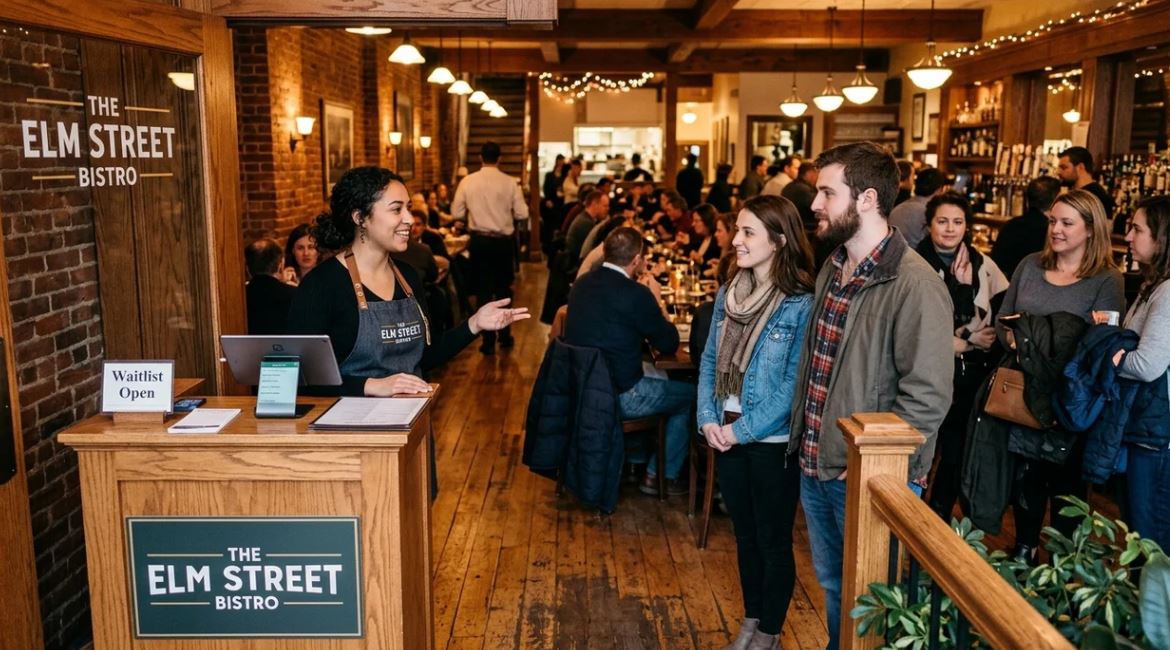
You’ll usually find them near the entrance with:
- A tablet
- A computer
- A reservation book
- A waiting list
Almost every restaurant interaction begins with the host.
That’s why learning host-related vocabulary is one of the fastest ways to improve your restaurant English.

The Most Common First Question: “How Many?”
This is probably the most common phrase you’ll hear.
Host:
“Hi, how many?”
Meaning:
“How many people are dining with you?”
Your answer should be short and simple.
Natural Responses
✅ “Table for two, please.”
✅ “Three, please.”
✅ “Party of four.”
✅ “Just one.”
Notice that Americans usually keep these responses very brief.
You don’t need to say:
❌ “I would like to request a table for two people.”
While grammatically correct, that sounds overly formal for a casual restaurant.
Instead, Americans prefer short, efficient responses.
Quick Practice
Host:
“Hi, how many?”
You:
“Table for two, please.”
Host:
“Hi, how many?”
You:
“Party of three.”
Simple. Natural. Professional.
Understanding Restaurant Reservations
After asking about your group size, many hosts ask another common question:
“Do you have a reservation?”
A reservation means you booked a table before arriving.
Reservations are especially common:
- On weekends
- During dinner hours
- At popular restaurants
- On holidays
- At upscale restaurants
Many English learners worry when they don’t have one.
Don’t.
It’s completely normal.
If You Don’t Have a Reservation
You can simply say:
✅ “No.”
✅ “No, we don’t.”
✅ “No reservation.”
That’s it.
No long explanation needed.
How to Give Your Reservation Name
If you do have a reservation, the host will usually ask for the name.
You might hear:
Host:
“Do you have a reservation?”
You:
“Yes, under Garcia.”
or
“Yes, under Ahmed.”
or
“Yes, under Fatima Ali.”
The word under confuses many learners.
In this situation, it means:
“The reservation is listed using this name.”
Think of it as:
“The reservation is stored under this name.”
Example Conversation
Host:
“Do you have a reservation?”
You:
“Yes, under Chen.”
Host:
“Great. Right this way.”
What Does “Right This Way” Mean?
This is another phrase you’ll hear constantly.
Host:
“Right this way.”
Meaning:
Follow me.
Come with me.
I’ll take you to your table.
Many learners try to translate every word individually.
Don’t do that.
Think of “right this way” as one complete expression.
Whenever you hear it, simply start following the host.
When the Restaurant Is Full
Sometimes you arrive and there aren’t any available tables.
This is extremely common in the United States.
The host might say:
“The wait is about 20 minutes.”
or
“It’ll be around 30 minutes.”
or
“We’re currently looking at a 45-minute wait.”
This does not mean you’ve done anything wrong.
It simply means:
There are no available tables right now.
Many popular restaurants have wait times, especially during busy periods.
How to Respond to Wait Times
The easiest response is:
✅ “Okay, that’s fine.”
✅ “No problem.”
✅ “That works.”
You can also ask follow-up questions.
Useful Questions
“Can we wait here?”
“Do you text when the table is ready?”
“Can I give you my phone number?”
“How long did you say the wait was?”
These are all common and natural questions.
Text Messages and Buzzers
Many restaurants use technology to manage waiting lists.
Instead of making customers stand near the entrance, they may:
Send a text message
Give you a buzzer
Use a restaurant app
That’s why you’ll often hear:
“We’ll text you when your table is ready.”
Or:
“We’ll send you a message.”
Understanding these phrases can make the waiting process much less confusing.
What Does “Party” Mean?
Here’s a word that surprises many English learners.
The host may ask:
“How many are in your party?”
At first, many learners think about birthdays, celebrations, or weddings.
But in restaurant English, party simply means:
Your group.
Nothing more.
Examples
One person:
“Party of one.”
Two people:
“Party of two.”
Four people:
“Party of four.”
Six people:
“Party of six.”
This is one of the most common restaurant terms in America.
Choosing Your Seating Area
Once a table becomes available, the host may ask about seating preferences.
One common question is:
“Indoor or patio?”
A patio is an outdoor dining area.
Natural Responses
✅ “Indoor, please.”
✅ “Patio is fine.”
✅ “Outside would be great.”
✅ “We’ll sit anywhere.”
Notice again how short Americans tend to be.
Restaurant conversations are usually quick and efficient.
Understanding Booths and Tables
Another common question is:
“Booth or table?”
A booth is a fixed seating area attached to the wall.
You’ll often see booths in:
- Diners
- Family restaurants
- Casual restaurants
A regular table typically uses movable chairs.
Natural Responses
✅ “A booth, please.”
✅ “A table is fine.”
✅ “Either is okay.”
✅ “Whatever’s available.”
All of these sound completely natural.
A Complete Real-Life Restaurant Conversation
Let’s put everything together.
Example #1: No Reservation
Host:
“Hi there. How many?”
You:
“Table for two, please.”
Host:
“Do you have a reservation?”
You:
“No, we don’t.”
Host:
“Okay. The wait is about 15 minutes.”
You:
“That’s fine.”
Host:
“Can I get your name?”
You:
“Samir.”
Host:
“Perfect. We’ll text you when your table is ready.”
You:
“Thank you.”
Example #2: With Reservation
Host:
“Good evening. How many?”
You:
“Four.”
Host:
“Do you have a reservation?”
You:
“Yes, under Garcia.”
Host:
“Perfect. Right this way.”
You:
“Thank you.”
Example #3: Seating Preference
Host:
“Would you prefer indoor or patio seating?”
You:
“Indoor, please.”
Host:
“Booth or table?”
You:
“A booth would be great.”
Host:
“Follow me.”
You:
“Thanks.”
Common Mistakes English Learners Make
Let’s look at a few mistakes that can make restaurant conversations sound unnatural.
Mistake #1: Being Too Formal
❌ “I would like to request a table for two individuals.”
✅ “Table for two, please.”
Mistake #2: Giving Long Explanations
❌ “Actually, we did not make any reservation because we were not sure what time we would arrive.”
✅ “No reservation.”
Mistake #3: Not Understanding “Party”
❌ “We aren’t having a party.”
✅ “Party of four.”
Remember: in restaurants, party means group.
Useful Restaurant Phrases to Memorize
Here are some high-value phrases worth practicing:
Getting a Table
- Table for two, please.
- Party of three.
- Just one.
Reservations
- Yes, under Smith.
- No reservation.
- We have a reservation.
Wait Times
- That’s fine.
- No problem.
- Can we wait here?
Seating Preferences
- Indoor, please.
- Patio is fine.
- A booth, please.
- A table is fine.
The more often you repeat these phrases, the more automatic they’ll become.
Practice Speaking Out Loud
One of the biggest mistakes English learners make is only reading.
Restaurant English is spoken English.
That means you should practice speaking these phrases aloud.
Try repeating:
“Table for two, please.”
“No reservation.”
“Yes, under Garcia.”
“That’s fine.”
“Indoor, please.”
“A booth would be great.”
The goal isn’t perfect grammar.
The goal is automatic communication.
When you’re standing in a busy restaurant, you won’t have time to translate in your head.
You want these responses to come out naturally.
Final Thoughts
Restaurant English may seem intimidating at first, but it’s actually one of the most predictable types of everyday conversation in the United States.
The same questions appear again and again.
The same responses work again and again.
And once you become comfortable with a few key phrases, you’ll be able to walk into almost any restaurant with confidence. ✨
Remember:
- Keep your answers short.
- Don’t worry about sounding formal.
- Learn common restaurant expressions.
- Practice speaking the phrases out loud.
You don’t need perfect English to get a table.
You just need a few reliable phrases and a little confidence.
In the next lesson, we’ll explore what happens after you’re seated, including menus, drinks, servers, and ordering food like a confident English speaker.